


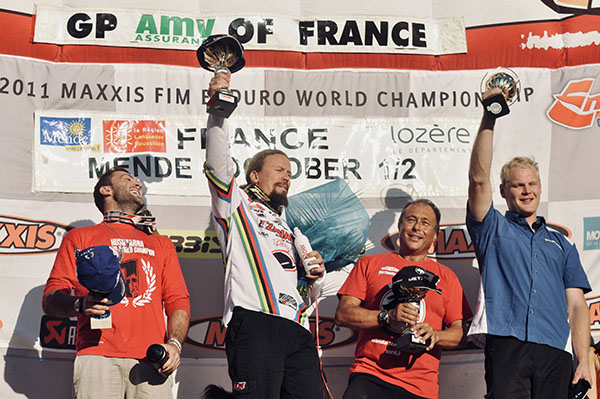
In Hämeenlinna, they dedicated a monument to him. Unveiled on 26 October 2018, it honours the memory of the King of Enduro, Mika Ahola, five-time world champion and the first rider to win a title in every class of the world championship: E1 (2008, 2009), E2 (2007, 2010), and E3 (2011).
He raced for twenty-one seasons and came out on top at a total of 71 GPs, always demonstrating unique talent. TM discovered him in the early 1990s and he moved to Pesaro in Italy. While there, he triumphed at two Italian championships and seven “International Trophies” at the International Six Days of Enduro (ISDE), the Olympics of motorcycling.
He won his world championships with the HM-Honda Zanardo team from Piacenza, after having also competed for Vor from Brianza and CH-Racing from Varese, the official Husqvarna team.
His relationship with Italy, however, went beyond racing and teams. In 1998, he moved to Cattolica, even if he only really liked it there during the summer. He also got married in Italy and then settled in Bobbio, in the Province of Piacenza. Together with Bergamo, it’s the Italian area with the greatest Enduro tradition.
In a 2007 interview with the website Moto.it, he explained that he honed his unusual skill of being able to succeed in all types of special tests and on pretty much any terrain in Italy. He said that normally Finnish riders tended to be strong on softer surfaces, like sand for example. Growing up, he often rode the official route in the small town where he was born. Here, generations of Finns, and not only future pros, have learned how to manage an Enduro motorbike. A lot of people in Finland consider this sport to be a winter discipline practiced in snow-covered forests and along frozen canals with studded tires. These Northern European competitions increase the Finnish riders’ resistance. They do, however, still find more technical passages in counter-slope or on rocks more difficult to handle.
Exactly these conditions abound in Italy and that is how Mika became a complete rider: he learned how to adjust easily to different race courses.
In Bobbio, he cultivated a hobby that at first does not appear compatible with the description of a man who lives for adrenaline and racing, even if Enduro does require a healthy amount of patience and composure. He often went fishing.
It was his way to relax, to have a meaningful dialogue with himself. Whoever was lucky enough to know him, could admire a rider with great determination and willpower, both of which were necessary to prove that there was a great career ahead of him. Before he became the celebrated and invincible rider of the 2000s, the expression “doing a Mika” already existed in the riders’ slang, but it meant doing something really impetuous or having bad luck ruin an almost secure victory at the last minute.
With his long hair and a taste for eloquent speech, he was truly passionate about this sport. The fervour with which he worked on himself to become a winner and to earn the respect of his rivals demonstrates this. Mika used his work ethic to fulfil a desire, an ambition. He was always willing to make more sacrifices, and to multiply his efforts, as long as he was achieving something that could justify everything and reward him. In the end, he obtained so much more than that. He got to where so many younger riders only dream of being.
He really enjoyed talking about Enduro. He liked to remember his successes, to confront himself with the present, and to understand which aspects to keep and which to improve in future. But he won’t be in that future, not as a main actor and not even as an honest and candid commentator.
At the age of 37, Ahola died on 15 January 2012 in Barcelona’s Teknon hospital. Different rumours about the cause of death immediately emerged, some mentioning illness, others problems in his private life. His widow, Marika, then clarified that Mika died of internal injuries that had not been diagnosed straightaway and were the consequences of a crash during a training session near Girona two weeks earlier. “After an agonizing stay in hospital, he tragically passed away at 19.28 on 15 January after the onset of serious complications”, Marika emphasised in a written statement.
Ahola had only just signed a contract with Jotagas, a brand-new team led by Jordy Tarres, the former trial champion, and Miki Arpa Bultò, the cousin of Sete Gibernau. He was about to leave HM Honda and the Jolly Racing Team to break in an unprecedented 300 2T. One last challenge for the King of Enduro.



