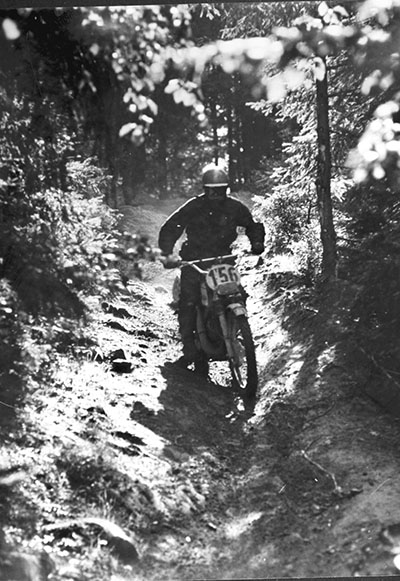
The street as a partner for life, the motorbike as a family history. Billy Uhl is born into the trade and wins his first ISDT gold medal in 1969. His father, Herb, rode motorbikes and Billy often accompanied him. When he was eight years old, they tried to put him on a two-stroke 125cc Harley Davidson, but he was still too small. The Uhl family was always on the move. “My father had a farm and a track that he sold for very little so we left”, he remembers. “We travelled a lot. Whenever we arrived somewhere new, dad accepted the first job he found. Then, maybe even during his lunch breaks, he immediately started looking for other jobs he might enjoy. So, after a while, we would leave and everything started again.” This is how he recalled it for Ed Youngblood in MotoHistory. When he was fourteen, Billy had already lived in twenty-eight different states before permanently settling in Idaho.
He started racing on a 50cc Honda which his father had modified for him. In the early 1960s, the Japanese manufacturer actually applied Herb’s adjustments to all their small-displacement off-road bikes. Young Billy’s talents were noticed early on. The 1969 ISDT was especially difficult. On 15 September, there were seventeen different nations at the start line in the Olympic Snow & Ice Stadium in Garmisch Partenkirchen, which is obviously more famous for ski than for motorcycle racing. The route for the first day included a very challenging climb to Hammersbach followed by timekeeping at Oberammergau and a pit stop at Altenau. After only a few hours, as many as twenty-three riders had withdrawn.
Uhl wasn’t even supposed to race at Garmisch but he was called at the last minute in order to replace another injured rider. Herb participated as well: they were the first father and son to compete together in the history of the event. The German press eagerly covered them.
As Billy told them, on the last day of the road-racing special test, “my Sachs was completely worn out. It had no power at all. Dad would slow down enough for me to tuck in his draft. Then he’d gradually tow me up to speed, and as we neared the next corner I’d slingshot around him”. That’s how he became the youngest ever American to win a gold medal. Together with Malcolm Smith, they were the only two Americans to win gold medals at Garmisch.
Uhl had never raced in a regularity competition before. His talent was noticed and John Penton hired him. Uhl then raced nine ISDTs in ten years, 1975 being the only exception because his sponsor that season, Can-Am, deemed the cost of participation in the event too high.
He won bronze in 1970 and withdrew from the Isle of Man ISDT of 1971 because of a broken motor. A year later, in 1972, he returned to win the gold medal. It was the first time he was part of the U.S. ISDT Trophy Team that was recognised both for “best effort” with the Watling Trophy and as “most improved” team.
The zenith of his career remains the 1973 edition in Dalton Massachusetts when he was the American with the most points, racing on a 125cc Penton.
“That was probably my biggest achievement in racing”, Uhl explained. “At the same time, it was an incredible low spot in my life”. His mother, who’d been ill for a long time, died while he was at the event. Her last wish had been to see her son race in the US.
In 1975, Uhl was awarded the All-Star Award by Motorcycle magazine. He retired in 1977, but returned to the world of racing in charge to design and preserve tracks. Some of the routes he created remain in perfect condition even decades after they were completed. Today, he uses his know-how and skills to teach not only young riders to drive. For example, he has instructed employees of telephone companies who have to travel to very remote areas, as well as Forest Service and Border Control agents.