


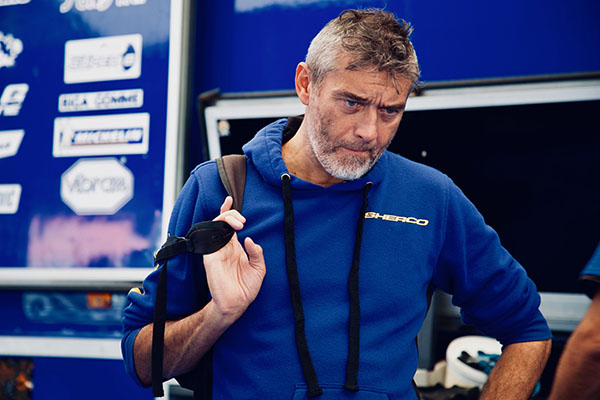
Almost everyone who has dedicated their life to Enduro has breathed motorcycling from a very early age. This story is no exception, but it’s also true that Fabrizio Azzalin approached motorbikes relatively late.
“My paternal grandfather repaired motorbikes, my maternal grandfather raced, my father was one of those who reopened the gates of Cagiva. I, on the other hand, did other things until I was 14 years old. I did what all the other kids my age did.”
He then joins his father at Cagiva and his passion explodes. He gains some experience and has the chance of a lifetime when he goes to manage the Husqvarna motocross team. This paves the way for many more adventures.
“I have a lot of memories from those years. I had the fortune to win everything there was to win. Having to think of a specific rider, Tiainen comes to mind, not only because of his results, but because of the fact that we have more or less the same age and grew up together: he as a rider, I as a Team Manager.”
Not only positive memories endure, but also those dramatic moments which make you wonder whether there is a point to what you do.
“The worst moment was when Gianpaolo Marinoni passed away during the Dakar.”
Motorcycling is a sport which can be dangerous and there’s no point in pretending there isn’t always a risk. However, certain tragedies leave their mark and there are only two ways to get over them: either you stop, or you go on because your passion is too strong.
The history of CH Racing is also the history of the friendship between Fabrizio and Mauro Cremonesi, who followed him from Cagiva. Every winter they look into each other’s eyes and decide to go on and continue writing the team’s thirty-year history.
“It’s clear that this would all be over if there wasn’t passion, even if it’s a job that enables you to make a living. If you don’t feel the desire to go to the competitions, if you don’t feel a fire burning inside you during the competitions, then you can’t do this job. It’s not an easy life: you’re always far away from home and certainly not amongst luxuries and splendours. If we didn’t love the sport this much, we would have never gotten to this point.”
The hard core of the team was formed during the years at Cagiva: he, Mauro, “and also Tullio Provini”.
“We are trying to create a future for this company and it’s also for this reason that we are recruiting young people who can continue the work done over the years. We teach them the profession, its secrets. However, one of the most important aspects is related to character. Life in a team isn’t easy. You live in a group and on the road. If you don’t have the right attitude, it’s impossible to maintain certain rhythms.”
Yes, company. He doesn’t use that word randomly. CH uses half its resources for racing; the other half, however, is dedicated to the distribution and sale of Sherco.
Racing and commerce are more closely intertwined in Enduro than anywhere else. There’s a strong bond between an EnduroGP team’s mechanics and the parent company.
“We often apply changes, or simply expedients, which are then applied to the commercial bikes. I really like working with Sherco because there aren’t too many filters. When you work with large companies you frequently have to wait for the enormous machine to set itself in motion in order to have a response. Even more frequently, that response doesn’t arrives.
With Sherco there is a very direct relationship. Everything becomes much quicker and more agile as we engage directly with the company’s owners.”
Fabrizio’s experience provides an excellent opportunity to focus on both the present and the future of Enduro.
“There might be tens of thousands of people at the competitions: I know for a fact that the majority of those people, who watch my riders compete with their opponents, own a motorbike. EnduroGP is the real Enduro. People follow it because they love this sport and really feel part of this movement. Authenticity is the key to success and guarantees a future.”
This doesn’t mean that EnduroGP stands still, that it always stays the same.
“2019 was a very important year. We had strong signs of growth. The organisation has also improved a lot which made it much easier for the teams and provided the audience with a wonderful show. The event at Ambert comes to mind; in my opinion, that competition really is exemplary: it’s logistically easy to organise for the teams, but it’s challenging for the riders and therefore fascinating for its sport performance.”
This is invaluable advice based on the knowledge and experience that enabled him to win many titles with different riders and brands. Mainly, however, it is the consequence of something that everyone who follows this sport and its World Championships has in common:
The Love for Enduro.



