


In 1990, the introduction of the Deutschmark also affected the planning of one of the historical regularity races in former East Germany, the “Rund um Zschopau”. The three young founders of the “Enduro and Mountainbike Club Witzschdorf”, however, managed to organise an off-road race for serial motorbikes anyway. It was a spontaneous idea which evolved into an established event with growing participation. This isn’t surprising: Zschopau is one of the capitals of German motorcycling. Motorbikes were produced here as early as 1922 when Jorgen Skafte Rasmussen bought an abandoned textile factory that he transformed into a pioneering research centre. He invented cars powered by steam engines called Dampf-Kraft-Wagen, acronym DKW, in German. The production had little success but the acronym remained the same when they started researching the two-stroke internal combustion engine. The first was known as “the kid’s desire”, “Der Knaben Wunsch” in German: acronym DKW. It was mounted on a bicycle with small adjustments and became the “grandmother” of the motorcycle. After a short while, Rasmussen produced his ten-thousandth engine and had another nickname ready: “the small miracle”, “Das Kleine Wunder”, acronym DKW yet again.
Serial production started as late as 1950 and, four years later, in 1954, the first Enduro competition was held in Zschopau. Soon after, the company’s motorbikes were distributed with a new brand name, VEB Motorradwerk Zschopau, abbreviated MZ. The first models with the new design were presented in 1962 and, by 1970, one million motorbikes had been produced. East Germany was absolutely dominant during the Trophy of the 1963 Six Days in Jilemnice, then Czechoslovakia, and the photos of the time show Werner Salevsky (MZ 250), Peter Uhlig (MZ 175), Bernd Uhlman (MZ 350), Horst Lohr (MZ 175), Hans Weber (MZ 250), and Günter Baumann (MZ 350). It was the beginning of a series of five victories at the ISDTs in the 1960s.
In 1972, MZ expanded its production also to include sidecars and the two-millionth model, a MZ ETZ 250, left the assembly line in 1983. In those years, Frank Schubert, Kurt Seidel, Manfred Jäger, Harald Sturm, Uwe Weber, Jens Scheffler, Mike Heydenreich, and Udo Grellmann rode the bikes from Zschopau with great success. This era of glory culminated in the organisation of the fourth stage of the 1990 World Championship, which was the first international event to be hosted in the town since 1972.
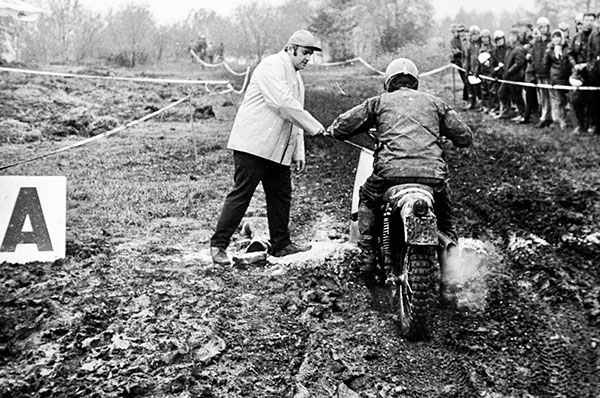
Reiner Weisbach, who was in charge of the organisation of all off-road races in Zschopau since the 1950s, created a respectable route with all the difficulties you would expect from a World Championship competition together with Andre Rudolph. It became even more challenging owing to cold and constant rain that lasted for the first two days of racing. Only 103 of 236 participants actually arrived at the finish line also thanks to the support of almost ten thousand enthusiastic fans. They were able to cheer on their idols: Mike Heidenreich, the Eastern German national champion in 1987; Jens Grüner; Harald Sturm; Andreas Cyffka; Thomas Bieberbach who later became World Champion on a Simson. Jens Scheffler, one of MZ’s iconic riders, ranked first at the end of the first day and second the next day.
MZ did not have a long life after this event: it was privatised in 1990 and went bankrupt in December 1991. Only the brand survived and its name was used by right-holders for a while until it was definitely closed in 2008. In Zschopau, however, they continued racing. The Enduro race of November 1995, initially forty kilometres long and then shortened after many riders crashed on twenty centimetres of snow, remains unforgettable. A year later, the local enduro and mountain bike club organised a mega-event with 180 participants and an even longer route of sixty kilometres according to the rules of the German Motor Sports Commission together with other associations like the MCV MZ Zschopau and the AMV Chemnitz.
In 1997, the challenge became even greater. Zschopau organised the fifth edition of the International November Enduro Finals of the German Championship. Always innovative, a senior competition was introduced in 1998 and the race got its old name “Rund um Zschopau” (“Around Zschopau”) back in 1999. From 2000, women could participate in the event.
In 2004, the German federation organised the stage in Zschopau as the last event of the World Championship. Its success exceeded all expectations: a crowd of 125,000 watched the tests and additional events.
A prologue with artificial obstacles along a shorter route was added in 2009 and the event continued being a crucial moment for German Enduro, even in 2012 when it didn’t actually take place: instead, a large part of its route was absorbed by the third and fourth days of the 87th ISDE that had its finish line at the Sachsenring.
This year, the “Rund um Zschopau”, which was overshadowed by Gunter Illgen’s death in 2013, returns to close the World Championship just like it did in 2017.



