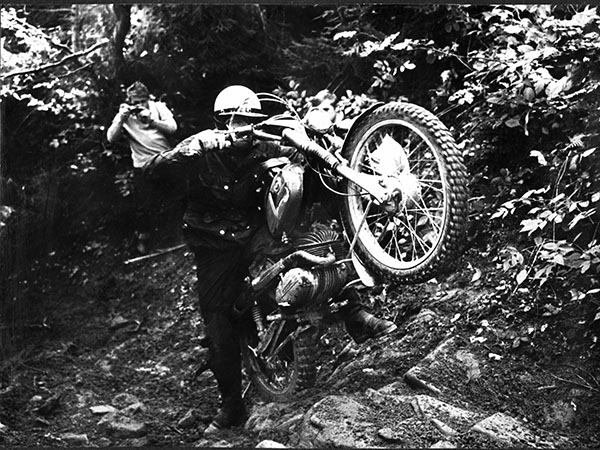
Even if he conquered the big screen with his smile, Malcolm Smith is not only the hero of “On Any Sunday”, the 1971 documentary film, in which he starred with Steve McQueen, another motorbike and racing fanatic. McQueen had participated in the International Six Days Trial in 1964 and wanted a true rider, a forerunner of off-road racing, at his side.
As is stated on his official website, Smith inherited his stubbornness and common sense from his parents who tried very hard to buy a motel in Palm Springs after the Second World War, but to no avail. Malcolm was born in Salt Spring Island in British Columbia, Canada, but he grew up in San Bernardino in California. His family moved there after their economic situation had worsened.
He discovers his passion for two wheels when he buys a Lambretta with his mother’s help in 1954. He rides it everywhere, even where he technically can’t. He sells it two years later in order to buy his first real motorbike, a 1949 500cc Matchless. With its famous winged M logo, Matchless started production in 1899 and is one of the oldest British manufacturers. Malcolm signs up for his first race in Moreno Valley in 1956 on this first bike.
Motorcycles give him freedom and Malcolm really wants to get to know them. He starts working in the local motorcycle shop, earns some extra cash with spare parts, and, most importantly, he learns the mechanics. He goes on to study aeronautic engineering for three years, but then returns to his first love becoming service manager for K&N in Riverside, California. He finds this job because he meets the owners of the shop, Kenny Johnson and Norm McDonald, in 1961. Five years later, Smith signs a contract of collaboration with K&N and acquires the entire service department.
His story is characterised by those meetings that change your life. The decisive encounter is the one with Edison Dye, the father of American motocross, who was selling Husqvarna motorbikes to especially selected clients in the United States at the time. Smith enters trade as well and also starts selling models produced by the Swedish company. In 1967, he founds Malcolm Smith Motorsports and wins his first gold medals at the International Six Days Trial and at the first Mexican 1000 (which is now called Baja 1000). The ISDT is the forty-second in history and it is raced at Zakopane, in Southern Poland, from 17 to 22 September.
Smith is forced to skip the 1968 edition because of a fractured leg, but he wins the gold medal also at the 1969 and 1970 ISDTs held respectively in Germany and Spain. His route from San Lorenzo de Escorial towards the north of Madrid during the Six Days has become part of “On Any Sunday”. Smith continues collecting victories in desert races, as well as gold medals at ISDTs. He achieves the latter again in 1971, in one of the most iconic venues in the history of motorcycling, the Isle of Man. It’s an extremely important year for the event, not only because of the death of the German rider Peter Uhlig a few days before the race. The ISDT on the Isle of Man is characterised by the struggle between the veterans on their four-stroke Ducati and Morini models and the new generation who prefer KTMs.
In 1973, Malcolm participates in the first ISDT held in the United States which is raced in Pittsfield in Berkshire County, Massachusetts. This choice of location is very courageous on the one hand, but not very enlightened on the other. There are many controversies, ambiguous incidents, and inexperienced commissioners who interpret the rules very strictly, but then forget to open the closed park on one of the days. Only 125 out of 303 riders actually get to the finish line. For the first time, a nation’s riders are allowed to drive foreign bikes even for the Trophy, and not only for the Silver Vase. It is because of this that a French team participates for the first time since the Second World War. The USA, all on Husqvarna, surprisingly win the Silver Vase, as they manage to make the most of their opponents’ breakdowns and crashes.
Smith continues amassing ISDT gold medals in 1974, in 1975 (when he wins the Roof of Africa in what many consider his best race ever), as well as in 1976. He wins eight of them in total and there’s a shirtless photo of him in which he proudly shows them off just like Mark Spitz did with his seven gold medals in swimming during the 1972 Munich Olympics. Without the edition he skipped in 1968, Smith races nine ISDTs in ten years: fifty-four days of the most exhausting competition in motorcycling without a single withdrawal or mechanical breakdown.
Smith creates Malcolm Smith Products and Malcolm Smith Adventures Inc. in order to take tourists around the Baja peninsula. In 1988, at the age of 46, he races the Paris-Dakar and finishes fourth in total and first American. “It was a war”, he says. “My forty-six-year-old body was exhausted, hungry, thirsty, and incredibly in pain. I was scared to death.”
He has created a foundation to help the orphans of Baja and entered the AMA Hall of Fame in 1996. Ten years ago, Smith was still the top seller of motorbikes in Southern California. He hasn’t lost his competitive nature and adventurous spirit, or that film star smile which had also attracted Steve McQueen.
Steve McQueen.