


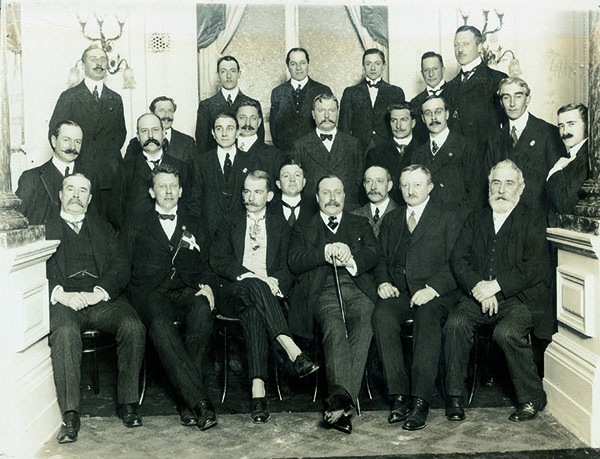
The Ledoyen is one of the oldest restaurants in Paris. Its history stretches back to the eighteenth century and, today, it hosts a gastronomical project developed by three-starred chef Yannick Alléno in collaboration with the Parisian Culinary Research and Education Academy. The Fédération Internationale des Clubs Motocyclistes, which later becomes the International Motorcycling Federation, is born there on 21 December 1904.
Its original members are five: Austria, Denmark, France, Germany, and Great Britain. The decision to associate is taken after the disputes over how the first edition of the International Cup at Dourdan, southeast of Paris, was carried out in September. It is a competition for motorbikes of up to 50kg raced along a 34-miles route. Three participants per nation are allowed according to the organisers and the French on three Griffon occupy the first three places. However, the British complain about the presence of nails and the race is declared invalid.
Two years later, the International Cup is raced in Patzau, Bohemia. The Austrians, French, and Germans vote to dissolve the FICM, but the organisation remains alive, even if inactive, thanks to ACU, the British Auto-Cycle Union. Great Britain is the centre of motorcycling, its trade and innovations, at the time: as early as 1906, the United Kingdom imports 1.747 motorbikes and exports 739, while the importations of petrol double compared to 1904.
ACU calls a meeting at London’s Olympia in order to reactivate the International Federation in 1907. They are successful, and supported by the delegates of Belgium, Denmark, France, Italy, Holland and the United States. Two weeks later, Sir Arthur Stanley is elected as president in a meeting at the Automobile Club de France in Paris. This is when FICM decides to hold an international trial during the ACU Trials of 1913. Each country can participate with three bikes, painted in specific colours: green for England, blue for France, white for Germany, white and blue for the US, yellow for Belgium, yellow and red for Spain, red and green for Austria, red for Italy, white and red for Switzerland, white and green for Denmark. This is how the first edition of the International Six Days Reliability Trial is born. It is also decided in the same meeting that the second edition should take place in France in 1914.
More and more nations join the Federation over the years: there are thirty-six at the outbreak of the Second World War. The number of competitions also increase. The first Speedway World Final is held in Wembley in 1936, and the first Motocross of Nations is raced in Holland in 1947. Two years later, FICM changes its name to Fédération Internationale Motocycliste (FIM) and the World Motorcycle Road Racing Championships with six tests for four classes (125, 250, 350, and 500 cc) are added to FIM’s calendar. The Tourist Trophy is launched. Honda creates its first motorbike, the D-Type Honda Dream with 3hp and 98cc capacity, in the same year. FIM is now recognised as international non-governmental organisation and establishes motocross championships in the 1950s. These become World Championships for the 500cc and the 250cc classes in 1957 and 1962 respectively. In 1959, FIM joins the Federation of Semi-Official and Private International Institutions based in Geneva (FIIG) and moves its headquarters from London to Geneva. There are over 330.000 motorcycles registered in England at this point.
The Individual European Two Days Championship is launched in 1968. It becomes the Enduro World Championship in 1990 and, from 1992, there is also a European Championship. There were attempts to organise a European Championship as early as 1964 and three tests were included in this experimental early stage: The Italian Valli Bergamasche, the Czechoslovakian Strakonice, and the Polish Zakopane.
The World Championships of 1990 are raced by six classes: 80, 125, 250, 350 and 500 (the latter with both two- and four-strokes). The winners are Thomas Bieberbach on a Simson, the legendary Brit Paul Edmondson on a KTM EXC 125, the Finn Kari Tiainen (who started his career in motocross) on a Suzuki RME 250, the Czechoslovak Otakar Kotrba on a Husqvarna, Peter Hansson on a KTMì, and Jimmie Eriksson Husaberg on a FE 500.
The 80cc and 500cc two-stroke categories disappear from 1993. More changes take place until 2004, when the mechanism is simplified in three more classes where one could compete with two- and four-stroke engines: Enduro 1, Enduro 2, Enduro 3. This happens for the Junior categories in 2005. Enduro Women is introduced in 2010. The point system is also reformed and the winner in each class gains 25 points, while the second gains 22 points and the third 20 points.
The year 2000 represents a great turning point for FIM as it becomes an IOC Recognised International Sports Federation.
One year later, it joins the WTO, the World Tourism Organisation, as an affiliated member.
Motorcycling is increasingly global.
The two wheels can take you anywhere.



