


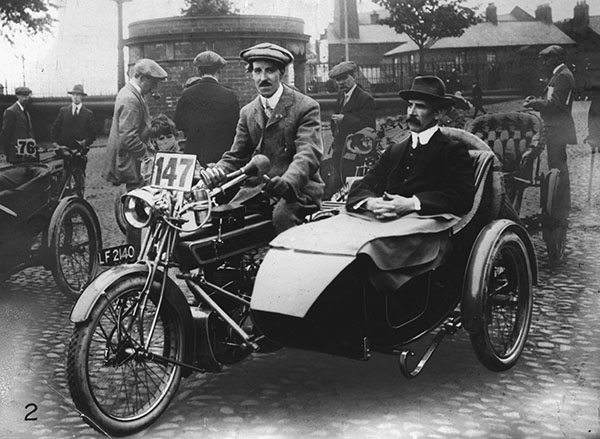
The sun is beating down on the streets of Carlisle, England. It’s 18 August 1913 and a certain R.E. Townshend starts on his Trump 6 hp. This is the beginning of the first “International Six Days Reliability Trial”, the first international Six Days competition organized by the Fédération Internationale des Club Motocyclistes (FICM). The approval of this event, which isn’t the first of its kind, was proposed by J. Nisbett, vice-president of the Auto-Cycle Union (ACU). Long-distance regularity races lasting six days have existed in England since 1903.
The International Federation recognises a race born a few years earlier and introduces fundamental rules, including the classification of the different bikes admitted to the competition in three categories. Motorcycles with 250, 350, 500, 750 or 1000 cc are in the first division. They need to have a minimum weight between 40 and 80 kilograms without oil or petrol depending on their engine size. The second division comprises motorbicycles with sidecar that have the same engine size and a minimum weight between 80 and 120 kilograms. One or two persons can be aboard the cyclecars in the third division. These are hybrids between a car and a motorbike which have a reduced engine size and can weigh a maximum of 300 kilograms without liquids. Drivers and passengers need to weigh at least 60 kilograms and women are not allowed to take part in the competition.
Travel time is fixed at circa 20 kilometres per hour. Penalty marks are foreseen for whomever arrives at the various checkpoints either too early or too late outside the eight minutes of tolerance for motorbikes and ten minutes for the other models. Speed trials take place on the last day.
The competition is regulated as a team race, with one squad per participating country. Eleven nations are expected on top of the English hosts but in the end only the French show up but they pull out quite soon. There’s 161 competitors between the trade riders and privates.
The route of the second day, Carlisle-Ingleton-Carlisle, covers 164 miles divided into five sections. Replacing parts or refuelling is not allowed. It is deemed much too difficult by the riders. Bikes are damaged and they complain to the organisation about an elevated risk of accidents especially on the mountain trails when descending while trying to respect the average speed. The contemporary press reports that six representatives ask that the route should only include more travelled roads and that the schedule time to be maintained along the route should be abolished. The organisers grant an increase of the tolerated time limit to fifteen minutes for the models with one rider and twenty minutes for the models with one rider and a passenger. Twenty-four of the participating private riders pull out of the race.
It rains on the last two days which makes the situation even trickier for the riders as water is one of their major enemies. In fact, puddles with a depth of up to twenty centimetres are spread along the route by the organisers. Then as now these are a major characteristic of English roads. The commissioners’ final report emphasises that the majority of damages are caused by the water, even if they don’t specify which models are affected more by this.
In division 1, the newspapers of the time describe a wonderful performance by De la Hay on a Sunbeam with a 2 ¾ hp engine. 51 gold, 22 silver, and 25 bronze medals are given out after having calculated the penalties. This shows just how appropriate the route is as it is challenging enough to differentiate between the different riders. Similar subsequent events under the aegis of FICM have less participants. However, this is only the beginning.



